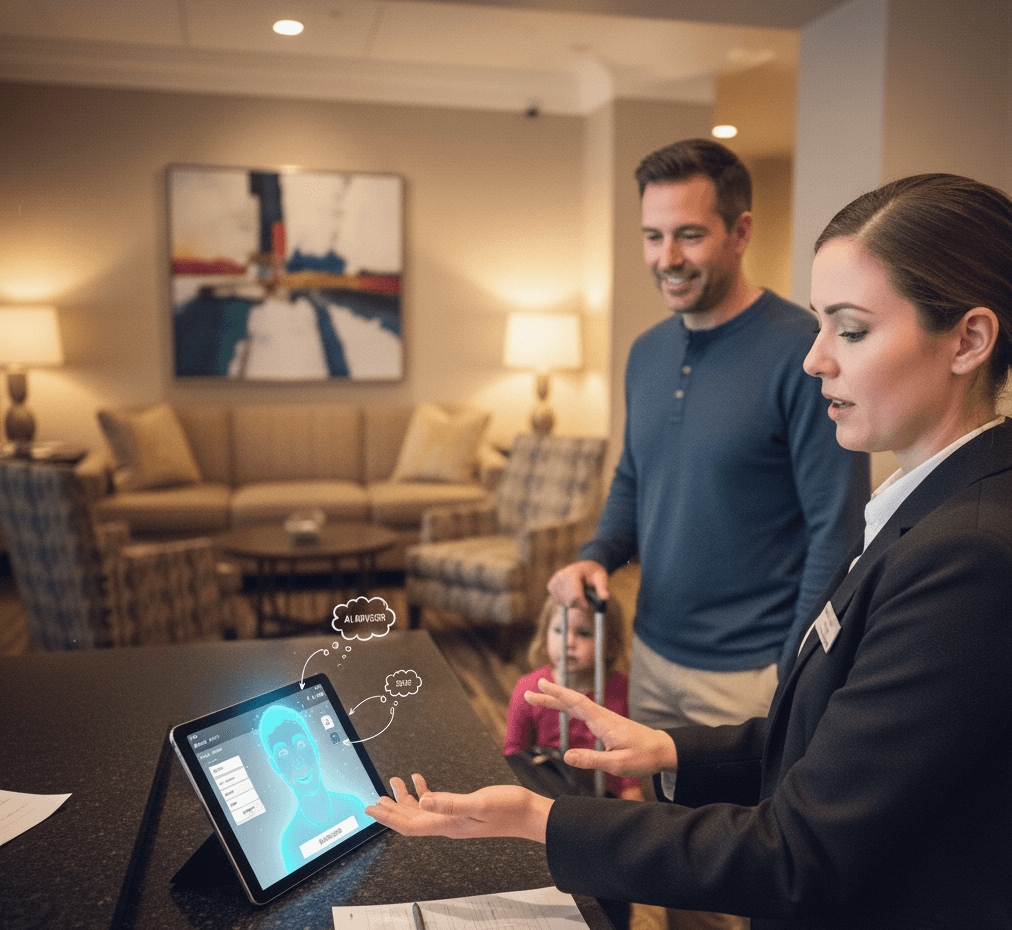
AI Mentors are solving the hotel industry knowledge gap
The hotel sector faces a persistent challenge: high staff turnover paired with the constant need for impeccable service standards. When a front desk manager spends three hours training a new receptionist on check-in procedures, that's three hours away from handling guest complaints, managing room allocations, or addressing the dozen other tasks that demand attention. Multiply this across departments—housekeeping, restaurant service, concierge, maintenance—and the time cost becomes staggering.
This training burden doesn't just affect productivity; it impacts service quality. When experienced staff are pulled away from their core responsibilities to train newcomers, something inevitably suffers. Either training becomes rushed and superficial, or guest service takes a hit whilst managers focus on bringing new employees up to speed.
AI mentors are changing this equation entirely. Rather than relying solely on human trainers who must balance training duties with their primary roles, hotels can now provide each staff member with a personal AI mentor available 24/7. These digital coaches understand the specific needs of your property, from your brand standards to your unique operating procedures.
Consider Maria, a new receptionist at a boutique hotel in Bath. She starts her shift at 7 AM, before the front office manager arrives. A guest approaches with a complex request: they need to extend their stay, add an extra guest to their room, arrange transport to Stonehenge, and split the bill between two payment methods. In traditional training scenarios, Maria would need to interrupt a colleague, possibly disrupting their workflow, or make mistakes whilst trying to figure things out on her own.
With an AI mentor, Maria opens a chat on her device. Within seconds, she's walking through each step of the process in natural conversation. "I need to extend a booking and add another guest," she types. The AI responds immediately, guiding her through your property management system's specific steps, reminding her about rate differences for extended stays, and prompting her to verify the room's maximum occupancy. When she asks about splitting the payment, the AI walks her through your exact process, referencing your hotel's policies on split payments.
This isn't a generic training module. The AI knows your property's systems, your brand voice, and your specific policies. It can answer questions about your hotel's unique features, from explaining the history of your Grade II listed building to detailing the locally sourced ingredients in your restaurant menu.
The beauty of this approach lies in its scalability. Whether you're training one person or fifty, the quality remains consistent. Every new hire receives the same high-quality guidance, yet each learning experience is personalised based on the individual's role, prior experience, and learning pace.
Think about the pressure this removes from your management team. Your front office manager no longer needs to choose between training staff and addressing urgent operational issues. Your head housekeeper can focus on quality control rather than repeatedly explaining the seventeen-step bed-making process. Your restaurant manager can concentrate on the evening service instead of drilling new waiters on the wine list during the lunch rush.
The AI mentor also addresses a problem that human trainers, no matter how dedicated, can't solve: availability outside regular hours. Hotels operate around the clock, but training typically happens during day shifts when experienced staff are available. A night porter starting their first solo shift at midnight previously had limited support. Now, they have instant access to guidance on everything from handling a fire alarm to processing a late check-in from a delayed flight.
The financial implications are substantial. Consider the cost of a senior team member's time. If your front office manager earns £35,000 annually, each hour of their time costs roughly £17. When they spend fifteen hours per month on basic training tasks, that's £255 of their salary devoted to work that an AI mentor can handle. Across a year, that's over £3,000 per manager—money that could be reinvested in service improvements or staff development programmes.
But the benefits extend beyond immediate cost savings. When experienced staff aren't constantly interrupted by training questions, they perform their primary roles more effectively. Guest satisfaction improves. Team morale strengthens because nobody feels they're neglecting their core duties to train others. And crucially, new staff feel supported without feeling they're burdening their colleagues with constant questions.
The technology adapts as your hotel evolves. Updated your breakfast service procedures? Changed your cancellation policy? Introduced a new room category? Simply update the AI mentor's knowledge base, and every staff member immediately has access to current information. No need to schedule training sessions, print new manuals, or hope that word-of-mouth spreads the changes accurately.
This doesn't mean human mentorship becomes obsolete. Rather, it elevates it. When your experienced staff aren't spending hours on basic procedural training, they can focus on the nuanced aspects of hospitality that require human judgement: reading guest emotions, handling sensitive situations, demonstrating the art of anticipatory service. The AI handles the "what" and "how," freeing humans to teach the "why" and "when."
Your housekeeping supervisor can spend their time coaching staff on the subtleties of luxury service—how to arrange personal items respectfully during turndown service, how to anticipate guest needs based on visual cues—rather than repeatedly explaining how to operate the bed linen press. Your senior concierge can share decades of local knowledge and relationship-building wisdom instead of drilling junior staff on basic reservation systems.
The ripple effects touch recruitment and retention too. New employees feel more confident when they have instant support, reducing the anxiety that often accompanies hospitality roles. They make fewer mistakes, receive more positive feedback from guests, and consequently feel more satisfied with their jobs. In an industry where staff turnover can exceed 30% annually, anything that improves new hire experiences deserves serious attention.
For multi-property groups, AI mentors create consistency whilst respecting individual property characteristics. A new employee transferring from your Leeds hotel to your Edinburgh property can access an AI mentor that understands both locations. The core training remains consistent—your brand standards, your service philosophy, your systems—whilst property-specific details adapt to the new location.
Implementation is straightforward. Unlike complex software rollouts that require extensive IT infrastructure, modern AI mentors work through simple chat interfaces on smartphones, tablets, or computers. Staff already know how to use chat—it's how they communicate with friends and family. The learning curve is minimal, and adoption happens naturally.
The data generated provides valuable insights too. Which procedures generate the most questions? Where do new staff consistently struggle? What time of day do training queries peak? This information helps you refine your operations, identify systemic issues, and target human training efforts where they're most needed.
Looking ahead, the hotels that embrace AI mentors will find themselves with a significant competitive advantage. In an industry where service quality directly impacts reviews, revenue, and reputation, providing staff with instant, accurate support whenever they need it isn't just nice to have—it's becoming essential. The question isn't whether hotels should adopt this technology, but how quickly they can implement it to relieve pressure on their teams whilst elevating their guest experience.
TravAI is an AI-powered training platform built specifically for tourism businesses facing these exact challenges. It creates an AI mentor trained on your organisation's content, brand voice, and expertise—capable of delivering training to both internal teams and external partners with the always available AI mentor.